Monday, December 5, 2016

The Iceman Cometh

Partially melted and refrozen ice "berries" on weed twigs.
I was at the lake last week to do more trout fishing, before the weather gets too brutal here at 7,000 feet in elevation. It gets me into the outdoors for several hours a day in a way that I otherwise wouldn't be. So it's good.

Standing in and walking around a relatively small area outside for hours allows me to relax into the scenery, the weather, while watching the birds move around doing their thing. Their things.

For instance, the other day when I got to the lake shore at my favorite, most productive spot, I saw that the lake was starting to freeze. Only in one small protected cove, but that's how it starts. It caused me to realize that I was going to get to watch the lake freeze over, stage by stage, for the winter. Then I will watch it lie dormant, frozen and snow covered through the "dead" of winter. Then watch it start to re-emerge in several months as springtime returns. I'm looking forward to that. I have the time, the convenient proximity to the lake, and the health to be out there daily if I want.

Early ice shelf on a protected cove on the lake.

Besides the beauty of the modest ice shelf itself, I became intrigued by some somewhat spherical "blobs' of ice that were on the stalks of weeds a few inches above the surface of the ice sheet. It wasn't hard to guess how they had come to be.

They formed when the lake level was as couple inches higher. It had been cold enough to freeze around the twigs a little bit, probably with a gentle lap of the water's surface with a gently breeze. That's my guess.

The Abajo Mountains in the distance, source of the lake's water.

Then the lake level dropped with the colder weather,  because the stream that feeds it reduced in flow as its headwaters in the mountain slopes above became frozen. The lake continues to evaporate slowly while its water supply from the mountains is all but shut off by winter's freeze up higher.

Ice berries on dead weeds, sparkling in the cold sunlight.

As for the ice "berries", the sunlight partially melted them during the day, while it stayed cold enough to not melt them entirely. Pretty amazing.

The ice berries were so gorgeous that I had to suspend my fishing to photograph them.

Rainbow trout, perfect pan frying size.
Photo location: San Juan County, southeast Utah.

Prints and photo products are available on my Fine Art America sales website:
http://stephen-krieg.pixels.com/


© Copyright 2016 Stephen J. Krieg


Friday, December 2, 2016

Snow Squall Lake Sunset

Snow showers at sunset time over the Abajo peaks.
I was at the lake, trout fishing. Yes, in late November at 7,000 feet. Pretty fortunate to have such cold (temperature near freezing) but not brutal winter weather yet. I'll take it as long as it lasts, because then it will be a long several months until spring.

Sunny most of the day, but lingering snow showers from the most recent light storm were cloaking the Abajo peaks. Like a veil dance they would cover, partially pull off, tease.

At the lake, the sun slid behind the southernmost peak, lighting the clouds from behind. A slight tinge of gold, but no strong reds this time. No matter. The spectrum of blues from light to dark to black, reflecting off the lake, was spectacular enough.

Photo location: Monticello, San Juan County, southeast Utah.

Prints and photo products are available on my Fine Art America sales website:
http://stephen-krieg.pixels.com/


© Copyright 2016 Stephen J. Krieg

Sunday, November 6, 2016

Winter Closes In: San Juan Mountains

Trout Lake, Colorado, after the fall colors.
I was back at Lizard Head Pass in the San Juan Mountains of southwest Colorado. Early November, and although rain and high elevation snow were about, it was rather warm for way up there at that time of year.

Sheep Mountain was lost in the clouds. My favorite peak was hiding.

Trout Lake was not. She was glassy, free of wind in the afternoon overcast light. The aspen leaves, with their vibrant fall colors, were long down.  But the the yellow dead grasses and forbs of the meadows had their own subtle glow.

New snow on Vermilion Peak, from Trout Lake, Colorado.
I stopped to photograph the last dangling golden leaves of a willow. In the wetness of the drizzling rain their color was that much more saturated.

Willow leaves in early November: last of the fall colors.
A cold front was moving in. I would have loved to have been there. But where would I stay? As many times as I've camped up there, the long winter nights seem even longer to me. I retreated to lower elevations. Like home.

Photo location: San Juan Mountains, southwest Colorado.

Prints and photo products are available on my Fine Art America sales website:
http://stephen-krieg.pixels.com/


© Copyright 2016 Stephen J. Krieg

Wednesday, October 19, 2016

Kachina Natural Bridge, Fall Colors

Kachina Natural Bridge, fall colors, from the Loop Road overlook.
It's mid October on the Colorado Plateau. Here in southeast Utah, Four Corners Country, the high country aspen fall colors are now gone. Now it's down to the lower elevations for the last of the colors. The cottonwood trees in the valley bottoms, in the canyon bottoms.

This is Kachina Bridge at Natural Bridges National Monument. The massive Cedar Mesa Sandstone walls are framed from below by the cottonwood and willow colors.

Photo location: Natural Bridges National Monument, San Juan County, Utah.

Prints and photo products are available on my Fine Art America sales website:
http://stephen-krieg.pixels.com/


© Copyright Stephen J. Krieg

Thursday, October 13, 2016

Fish and Fall Colors, Abajo Peak

Aspen fall colors and Blue Spruce, Abajo Peak Road.
October, the perfect month. Warm days, chilly nights, fall foliage colors. Here I am still in southeast Utah, enjoying the scenery, clean air, small town atmosphere, wide open spaces.

Rainbow Trout, perfect pan frying size, too.
Not only that but I recently bought my fishing license, after being away from it for decades. Following a tip from a local, I was soon catching my limit of four trout from a local lake. They are in the 9 to 12 inch range, perfect for pan frying.

Aspen at peak fall colors, Abajo Peak area.
 So having once again caught my limit that morning, I drove up Abajo Peak Road to see how the aspen colors had progressed in the past week. Pretty magnificent, at peak colors.

Aspen fall foliage backlit by the midmorning sunlight.
From up near the summit of Abajo Peak, I noted how the uppermost aspen clones, the ones that had turned the earliest, were now done, their leaves dropped. Now it was time for the lower elevation forest groups to show off their peak colors.

Looking southeast from Abajo Peak.
Photo location: Abajo Mountains, near Monticello, Utah.

Prints and photo products are available on my Fine Art America sales website:
http://stephen-krieg.pixels.com/


© Copyright 2016 Stephen J. Krieg

Sunday, October 2, 2016

Southwest Colorado Fall Colors

Colorado Blue Spruce trees in aspen stand, September 24.
I stopped in at the Sunshine Campground not far south of Telluride, Colorado on the Uncompahgre National Forest. I wasn't camping, I was looking for new views of aspen fall colors.

Quaking Aspen leaves at peak color, southwest Colorado.

Aspen leaves against a dark green background of spruce trees makes them look like they are shimmering.
There had been a dusting of early snow on the highest peaks.

 Photo location: San Juan Mountain Range, southwest Colorado.


© Copyright 2016 Stephen J. Krieg

Wednesday, September 28, 2016

Aspen Colors From Abajo Peak

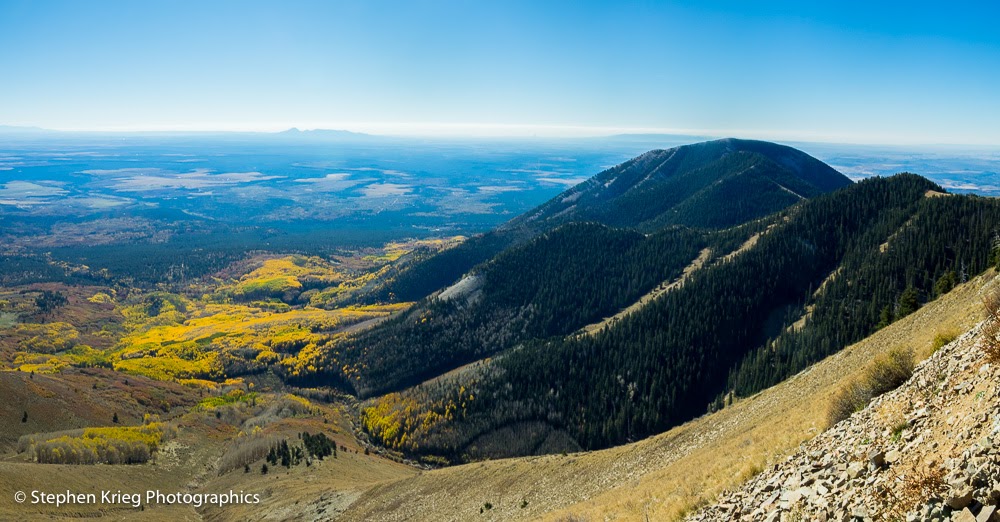
Fall colors nearing their peak on the lower slopes of the Abajo Mountains, September 25.
The Abajo Mountains are a small mountain range near Monticello and Blanding in southeast Utah.

It's a small mountain range because in geologic terms it's a laccolith -- a spot in the Earth's crust where magma was forced to the surface without breaking the surface. No lava flow. More like a group of skin blisters that hardened in place.

The tallest peak is Abajo Peak, 11,330 feet in elevation at its summit. It's often called Blue Mountain by the locals, or even "the Mountain". It's public land, on the Manti-La Sal National Forest.

The aspen colors have been nearing their peak in the high country of Utah and Colorado. So on a sunny Sunday morning I drove up to the summit of Abajo Peak for a look around from above.

And in this photograph you can see how much elevation affects vegetation, in this case aspen forests. Notice how the aspen stands (clones, actually) at the upper elevations are at their peak fall color, while the lower slopes are still mostly green, just beginning to turn colors.

Photo location: Abajo Peak, Manti-La Sal National Forest, San Juan County, southeast Utah.

© Copyright 2016 Stephen J. Krieg