Showing posts with label fall colors. Show all posts

Sunday, October 7, 2018

October Again

Fall Colors along Last Dollar Road.
October, the perfect month. The one I wait for all year.

And this year it seems even more sweet than usual. Because we've lived through an Exceptional drought (who knew there was a category beyond Extreme?) and now the fall rains have been falling and soaking in.

Aspen colors from the east end of Last Dollar Road.
It could have been a very dry autumn, too, but so far we're looking up at the rain falling.

Orange aspen colors, Last Dollar Road.

There is snow falling on the high peaks, but for the most part I can't see it yet; the clouds are keeping them secret for now. Soon enough. Hopefully for some photos of the remaining fall colors with the snowy peaks on the skyline.

Cottonwood colors, San Miguel River, Colorado.
See much more of my photography at www.NaturalMoment.com.

© Copyright 2018 Stephen J. Krieg

Tuesday, October 2, 2018

Colorado Fall Colors, South Fork San Miguel River

Looking down at the upper South Fork of the San Miguel River, October 1, 2018.
After a slow start the past few weeks due to warm temperatures, the fall colors in the high country of southwest Colorado have picked it up.

Highway 145 stormy day fall colors near Telluride, Colorado.
Some might call this "peak colors", but I don't. It's close, though. Still a lot of green aspen leaves mixed in with the yellow. And now we have rain pushing in from the south due to a hurricane turned tropical storm that made landfall on the Baja Peninsula. But it's relatively warm rain. So it will be interesting to see how things continue to play out for the rest of this week.

Photo location: Along Colorado Highway 145 south of Telluride, Colorado.

See much more of my photography on my website: www.NaturalMoment.com.

© Copyright 2018 Stephen J. Krieg

Saturday, September 29, 2018

Fall Colors On The Uncompahgre Plateau


La Sal Mountains in Utah, from Colorado's Uncompahgre Plateau. 
This autumn of 2018 seems to be progressing well despite an exceptionally dry summer. Since this is only my first season living in this area of southwest Colorado it will be interesting to experience more years and compare them.

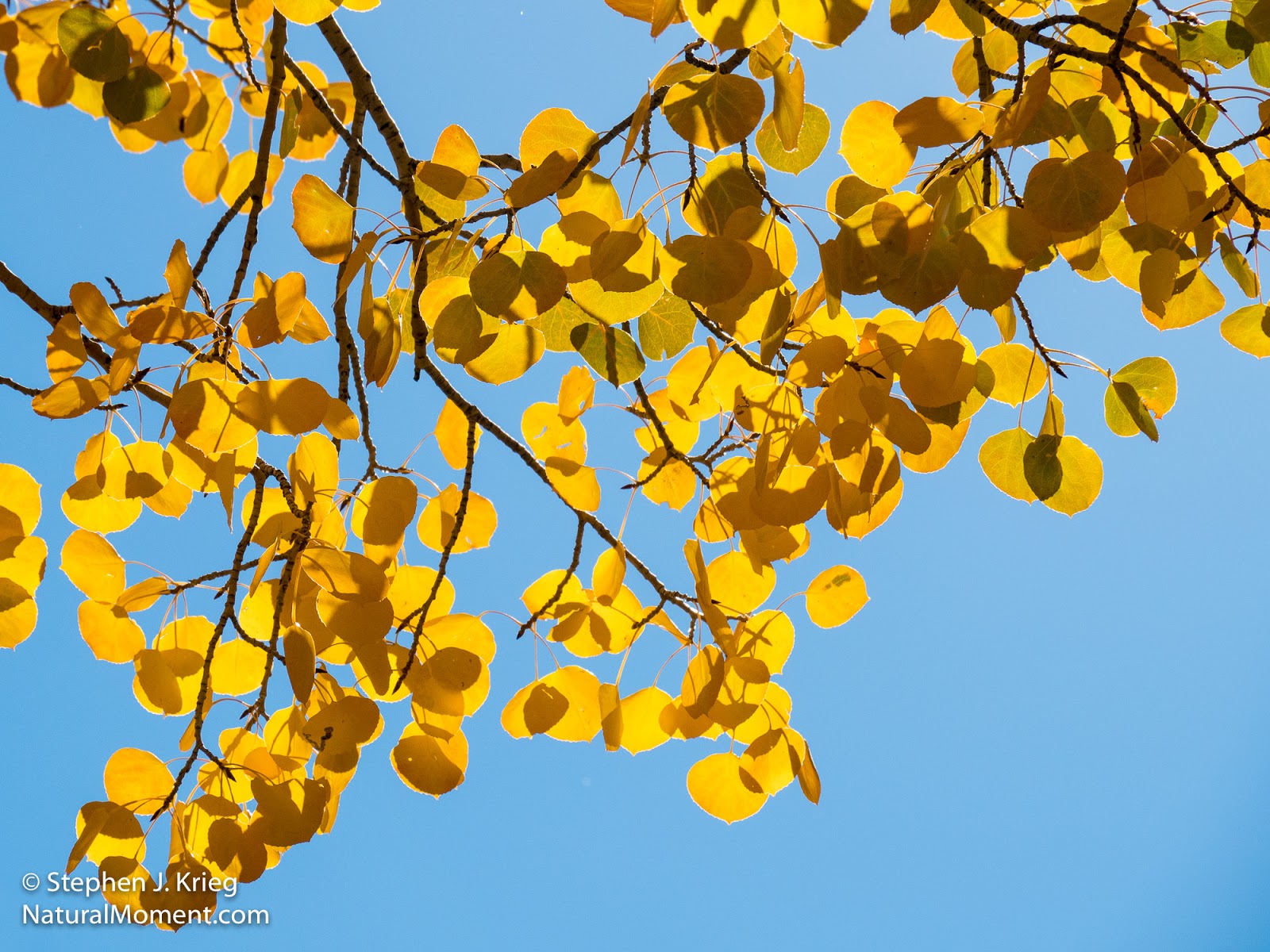
Aspen leaves backlit by afternoon sunlight.

I drove up onto the mighty Uncompahgre Plateau from Nucla, Colorado to see how things were going. And to visit a dying wildfire.

Glowing autumn aspen leaves against the dark greens of spruce trees.

The backbone road of the Uncompahgre is the Divide Road. Once I was onto it I headed west, toward the control lines of the Bull Draw Fire, still smoldering over 36,000 acres. Interestingly, despite the shorter days and much cooler nights the fire was still putting up visible smoke. Why? The falling aspen leaves. They quickly dry and give the ground fire paper-like fuel to advance, especially up steep forest slopes.

Remains of the Bull Draw Fire from over the ridge.

As I approached the northeast edge of the fire, the smoke was turning the forest road opaque. The firefighters were there on their patrol, watching for spot fires on the other side of the road, which was their major control line. I stopped to talk with one of them. Since I had once been a forester we could "talk turkey" about wildfire and control methods.

Fire Crew on the Divide Road containment line of the Bull Draw Fire.

The firefighters had used aerial ignition from a helicopter to "make black" just below the forest road. Meaning that by burning it in a controlled manner they could starve any uphill racing fire from having fuel to continue.

Smoke through the burned aspen forest, Bull Draw Fire.

I turned around to descend back down off the Plateau to Nucla. It was nearing sunset and the lowering sunlight was lovely.

The Bull Draw Fire had been caused naturally, by lightning. It had been allowed to burn because for about a hundred years the natural fires had been unnaturally suppressed, which has created today's firestorms in the West. But this fire had occurred in an exceptionally dry year, and it had gotten away. Way away. Very expensive to contain until late fall or winter weather finally puts it out. Managing our public resources is not easy.

Fall colors from the edge of the Uncompahgre Plateau. 

Photo location: Uncompahgre Plateau, Uncompahgre National Forest, southwest Colorado.

See much more of my photography at www.NaturalMoment.com.

© Copyright 2018 Stephen J. Krieg

Thursday, October 12, 2017

High Peaks Sunrise and Valley Fall Colors

Moon setting at dawn, Rico, Colorado, October 7.
October 7, and I was driving up the Dolores River valley in southwest Colorado for another day of experiencing the fall colors. It was still dark as I left Cortez, and cruised through the town of Dolores.

Approaching Rico, dawn was occurring. When it got light enough to take decent landscape photos, I made some compositions with the just past Full moon getting ready to set behind the San Juan Mountains with their aspen forests fall colors.

Dawn at the beaver ponds on the edge of Rico.
At the edge of town I turned off on a gravel road that I knew bordered some old beaver ponds. A nice wide open view of the mountains, and a glassy reflection provided by the water's surface.

Sunrise on the high peak, above and below.
I was about to continue on my way when the sunrise lit up a high peak above timberline with an orange glow. And reflected on the pond's surface.

See more of my photography on my website: www.NaturalMoment.com.

Photo location: Rico, southwest Colorado.

© Copyright 2017 Stephen J. Krieg

Tuesday, October 3, 2017

Rico, Colorado Fall Colors

Fall colors from Rico Community Church on an overcast morning, September 30, 2017.
As I track the progression of the fall colors in the San Juan Mountains of southwest Colorado, I return again and again to the tiny community of Rico. Once the county seat when it was a mining boom town, it's now part tourist destination, part bedroom community for people working in Telluride.

At about 8,800 feet in elevation it's a good bellweather of what's going on in the high country, ringed by high mountain peaks.

Fall colors on a sunny afternoon, October 7, 2017.
I returned a week later, on a perfect early October day. Warm, no haze to speak of, and no wind.

Photo location: Rico, Colorado.

See more of my photography on my website: www.NaturalMoment.com.

© Copyright 2017 Stephen J. Krieg

Wednesday, October 19, 2016

Kachina Natural Bridge, Fall Colors

Kachina Natural Bridge, fall colors, from the Loop Road overlook.
It's mid October on the Colorado Plateau. Here in southeast Utah, Four Corners Country, the high country aspen fall colors are now gone. Now it's down to the lower elevations for the last of the colors. The cottonwood trees in the valley bottoms, in the canyon bottoms.

This is Kachina Bridge at Natural Bridges National Monument. The massive Cedar Mesa Sandstone walls are framed from below by the cottonwood and willow colors.

Photo location: Natural Bridges National Monument, San Juan County, Utah.

Prints and photo products are available on my Fine Art America sales website:
http://stephen-krieg.pixels.com/


© Copyright Stephen J. Krieg

Thursday, October 13, 2016

Fish and Fall Colors, Abajo Peak

Aspen fall colors and Blue Spruce, Abajo Peak Road.
October, the perfect month. Warm days, chilly nights, fall foliage colors. Here I am still in southeast Utah, enjoying the scenery, clean air, small town atmosphere, wide open spaces.

Rainbow Trout, perfect pan frying size, too.
Not only that but I recently bought my fishing license, after being away from it for decades. Following a tip from a local, I was soon catching my limit of four trout from a local lake. They are in the 9 to 12 inch range, perfect for pan frying.

Aspen at peak fall colors, Abajo Peak area.
 So having once again caught my limit that morning, I drove up Abajo Peak Road to see how the aspen colors had progressed in the past week. Pretty magnificent, at peak colors.

Aspen fall foliage backlit by the midmorning sunlight.
From up near the summit of Abajo Peak, I noted how the uppermost aspen clones, the ones that had turned the earliest, were now done, their leaves dropped. Now it was time for the lower elevation forest groups to show off their peak colors.

Looking southeast from Abajo Peak.
Photo location: Abajo Mountains, near Monticello, Utah.

Prints and photo products are available on my Fine Art America sales website:
http://stephen-krieg.pixels.com/


© Copyright 2016 Stephen J. Krieg
Sunday, October 2, 2016

Southwest Colorado Fall Colors

Colorado Blue Spruce trees in aspen stand, September 24.
I stopped in at the Sunshine Campground not far south of Telluride, Colorado on the Uncompahgre National Forest. I wasn't camping, I was looking for new views of aspen fall colors.

Quaking Aspen leaves at peak color, southwest Colorado.

Aspen leaves against a dark green background of spruce trees makes them look like they are shimmering.
There had been a dusting of early snow on the highest peaks.

 Photo location: San Juan Mountain Range, southwest Colorado.


© Copyright 2016 Stephen J. Krieg

Wednesday, September 28, 2016

Aspen Colors From Abajo Peak

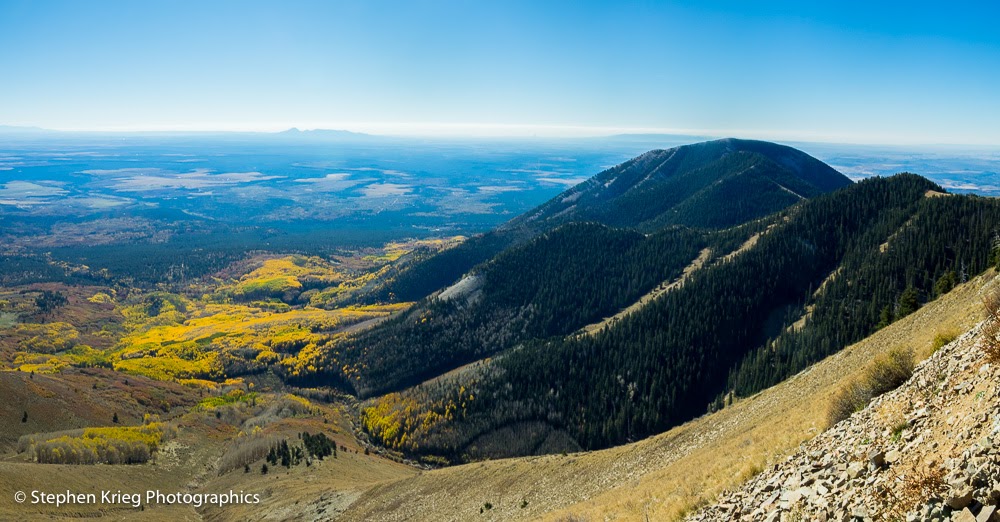
Fall colors nearing their peak on the lower slopes of the Abajo Mountains, September 25.
The Abajo Mountains are a small mountain range near Monticello and Blanding in southeast Utah.

It's a small mountain range because in geologic terms it's a laccolith -- a spot in the Earth's crust where magma was forced to the surface without breaking the surface. No lava flow. More like a group of skin blisters that hardened in place.

The tallest peak is Abajo Peak, 11,330 feet in elevation at its summit. It's often called Blue Mountain by the locals, or even "the Mountain". It's public land, on the Manti-La Sal National Forest.

The aspen colors have been nearing their peak in the high country of Utah and Colorado. So on a sunny Sunday morning I drove up to the summit of Abajo Peak for a look around from above.

And in this photograph you can see how much elevation affects vegetation, in this case aspen forests. Notice how the aspen stands (clones, actually) at the upper elevations are at their peak fall color, while the lower slopes are still mostly green, just beginning to turn colors.

Photo location: Abajo Peak, Manti-La Sal National Forest, San Juan County, southeast Utah.

© Copyright 2016 Stephen J. Krieg

Tuesday, September 27, 2016

Fall Colors in Colorado

Historic Trout Lake Trestle, near Trout Lake, Colorado.
I was up in the San Juan mountain range in southwest Colorado again. Another high country fall season, another compelling reason to get back up there and experience it again.

For me the autumn colors of the aspen stands are the crowning glory of fall there. But there are many more subtle shades of color down low to the earth. Shrubs, forbs, grasses. Yellows, reds and browns set against the deep greens of the conifer trees.

For this photograph, I had been driving the forest road between Trout Lake and Lizard Head Pass. It pretty much follows the route of the historic railroad that ran there in the late 1800's. So it's an easy drive for any vehicle, since trains can't handle steep grades.

In this photo, I stopped to photograph the Trout Lake Trestle, with the mountain brook tumbling beneath it and one of the first snows of fall on the distant peaks.

Photo location: Uncompahgre National Forest south of Telluride, San Miguel County, Colorado.

© Copyright 2016 Stephen J. Krieg

Sunday, October 11, 2015

Fall Colors and First Snow, Colorado

Aspen fall colors and first snow, from Highway 145, San Miguel County, Colorado. (Click image for larger.)

Fantastic aspen fall colors, and the first snow above on the high peaks above treeline. Perfect. A perfect October. 

It doesn't happen like this often. Deciduous trees such as quaking aspen have their own needs. Their leaves are out in the spring and summer to manufacture food, courtesy of the sun's power, and the Earth's nutrients. 

Then, come autumn, the leaves are shed in order to ride out the winter in comfortably wrapped-tight dormancy. 

When the leaves are shed tells the tale. If it's a harsh end to summer, with a hard frost or early snow, our tree friends pretty much just dump their foliage. See you in the spring. But if it happens to be a nice, gentle fall, with cool nights -- not freezing hard yet -- and clear sunny days, then the trees aren't in such a hurry to close the shutters. They slowly back off on their supply of green chlorophyll to their leaves, with its green color that has been masking other colors all along. Like yellows, golds, reds. 

Thus autumn is a kind of forest-weather courtship. A quick breakup, or a love for the ages. It's weather that decides how the date goes.

Which brings us to this year -- 2015 -- in the Four Corners region of southwest Colorado, southeast Utah, and northern Arizona and northwest New Mexico. 

And what an autumn it has been here. Slow and easy, gradual with some rain and snow up on the highest southwest Colorado peaks. But not down lower. Not down in the aspen-spruce-fir forests. 

Fortunately I have been able to experience it myself. In the San Juan mountain range between Rico and Ridgway, Colorado. Of the may photographs I made last week there, this is one of my favorites. The marriage of mountains and forests in autumn in Colorado.

Photo location: San Miguel County, Colorado.

© Copyright 2015 Stephen J. Krieg

Sunday, September 21, 2014

Aspen Colors Closeup, Kaibab Plateau

  
[Photo: Aspen leaves, Kaibab National Forest, Arizona].


Autumn continues its slow but gradual progression up on the Kaibab Plateau on the northern Arizona Strip. Warm, shortening days along with cool nights still free of frost or an early snow are doing the job. Those conditions tell the aspen trees that there is no hurry to drop leaves. A gradual lessening of the green chlorophyll in their leaves reveals the other colors, especially yellow and gold, sometimes orange and red.

I was slowly cruising through the Kaibab National Forest between Jacob Lake and the North Rim of Grand Canyon, looking for the earliest colors. In the morning light I was able to get close to some lower branches with outstanding colors. The Still green foliage of the other trees behind it served as a rich background to contrast with, along with the clear blue sky.

Autumn gold, blue skies, warm sunlight, chilly nights. The best time of year.

Photo location: Kaibab National Forest, North Kaibab District, near DeMotte Park, Arizona. 

Wednesday, December 12, 2012

Willow Leaves, Granite Creek


Mid December along the Granite Dam Trail in the Granite Dells just north of Prescott, Arizona.

The last autumn leaves of the willows along Granite Creek lie on the water's surface, the gentle current arranging them into patterns.

A serene morning along the trail, no other hikers around.

See my NaturalMoment YouTube channel of nature videos, too.

Thursday, October 20, 2011

Photographing Fall Foliage Close Up

[Photo: Gambel Oak fall foliage colors, Arizona]
Gambel Oak Leaf, Coconino National Forest, Arizona

To make an outstanding photo of tree leaves, especially in the fall, you don't need a really expensive camera and lens, or special filters or techniques. All you really need is your eyes, your brain, and your feet. 

Granted, this photograph was made with a fairly expensive DSLR camera, but all it did was to give me more control. I would have gone about this shot the same with with a point-and-shoot camera. 

This photo is engaging primarily because of its rainbow like range of colors. Red, orange, yellow, green, blue. But it also gives the feeling of depth,  of being there, even though you're looking at it on a flat screen. 

Why? Contrast. The leaf is in focus, while the background is blurry. Feeling of depth. The colors in the background contrast with the colors in the leaf. Also, I walked around until the sun lit up the leaf from behind. But in a position that it was not only backlit, but had the dark green of the conifer trees and the deep blue of the clear Arizona sky as the background.

I was close enough to the leaf, and the pine trees were far enough away, for them to be blurry no matter what lens aperture was used. All I needed was a lens aperture deep enough to have the entire leaf in focus. Or nearly all of it. 

You might also be interested in my Grand Canyon Photography blog.

See more of my photography at www.naturalmoment.com